Our Attitudes Betray Us
“If your church isn’t telling you to love your enemies but keeps telling you who your enemies are, you’re not really in church,” writes author and comedian John Fugelsang. I find his words especially pertinent in today’s alleged Christian America. Churches should be known for their unequivocal love for all people, but much of the rhetoric coming out of churches and church leaders today is filled with vitriol and hate, and not at all modeling the footsteps of Jesus.
Franklin Graham, son of evangelist Billy Graham, was invited to speak at the Pentagon this past Christmas. He chose as his text passages from 1 Samuel and Exodus, rather strange choices for the Christmas season. But what was even more inexplicable was his message. His sermon focused on hate, not love.
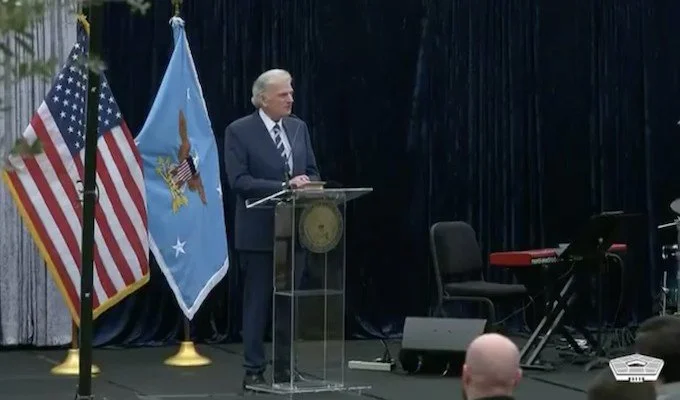
Franklin Graham
One would think that he would have preached “Good tidings of great joy to all people” (Lk. 2:10). After all, many in his audience may not have been familiar with the Gospel story, and the birth of Jesus was God’s greatest gift and his most outrageous expression of love to every human being. But that’s not the message Franklin Graham gave to the members of the Pentagon. Graham selected Old Testament passages that are some of the most controversial texts in scripture.
Graham cited God’s ostensible command to Samuel to instruct King Saul to slaughter the Amalekites—men, women, children, infants, and even their animals. I can’t think of a more inappropriate message during the Christmas season or any season, for that matter. What drove him to select some of the most theologically complex passages in scripture and interpret them in a way that placed God on the same level as the Greek and Roman deities who delighted in wreaking havoc and vengeance on their subjects? To think that these passages reveal the God of Jesus is to misunderstand the Judeo-Christian faith.
There are many places in the Bible that don’t square with the God revealed in Jesus. Passages where God presumably commands the murder of innocent people have long troubled scholars and people of faith who take the Bible seriously. Is it possible that these passages are more a reflection of what Israel thought God was telling them to do than what God actually said?
We can, of course, understand these passages literally, the way Franklin Graham does, but a literal reading of scripture is not always the best way to interpret the Bible. Perhaps we should read them as expressions of an immature Israel, a community of faith that was slowly growing in their understanding of God, and in their infantile spirituality projected onto God their baser moral standards that had been ingrained in them through their contacts with their non-Jewish neighbors. Prejudice, bigotry, homophobia, and hate are attitudes common to human nature, and these dark attitudes are hard to overcome, as we Americans are finding out first hand.

Only in the coming of Jesus, almost a millennium later, would God’s love be more fully revealed. There are certainly ample verses in the Old Testament that tell of God’s love and compassion for all the nations of the earth (see Amos 9:7), but they are also mixed in with passages that show a more malevolent god too. So, how are we to know that the more malevolent picture is more a reflection of Israel’s immaturity than God’s true nature of love?
The answer lies in the person of Jesus. He came to expand our understanding of scripture and reveal God’s true feelings. If you want to know what God is like, you don’t have to look any further than Jesus. Jesus went about doing good, caring for people from all walks of life, both Jewish and non-Jewish. He healed a pagan centurion’s servant, dined with tax-collectors, forgave sinners, and praised a foreign Samaritan for his compassion. He even went so far as to say that when you see his works, you were seeing the works of God (Jn. 14:9). Wow!

Honestly though, how many people believe every word of the Bible literally anyway? Through my years as a pastor, I heard well-meaning people say, “If the Bible says it, I believe it.” Really now, if people read the Bible seriously, they could never hold to such a literal reading of scripture.
Just a few examples to prove my point: The Bible commands that we put to death anyone who works more than six days in the week (Ex. 31:15). The Bible forbids divorce, but not polygamy. For acts of disobedience against God, a literal reading of scripture horrifyingly tells us, God will punish Israel by having parents eat the flesh of their sons and daughters (See Lev. 26:29. There are many more texts like this one). According to the Bible, rebellious sons are to be taken to the city gate and stoned (Deut. 21: 18-21). The Bible even condones selling daughters as slaves (Ex. 21: 7-8). In 1 Samuel 6 God kills 50,000 people for merely looking into the Ark of the Covenant. Just for looking, mind you. Shades of Raiders of the Lost Ark! Well, I think you get the idea. No one who has seriously read the Bible believes the Bible literally.
When I was a student in seminary, we discussed many of these difficult and controversial texts in scripture, translated the verses from the Hebrew or Greek, exegeted them, and wrote research papers on some of them. At the end of the day, the hate passages are irreconcilable with God’s nature and are problematic for people of faith. Our professors warned us not to build our theology of God on these obscure and textually difficult passages, but rather focus on how Israel’s understanding of God grew over the centuries, becoming clearer in the teachings of prophets like Isaiah, Micah, and Hosea. These prophets preached of a loving, forgiving, and compassionate God, and they anticipated the coming of a more complete revelation who would reveal the divine nature—Jesus (Matt. 5:17).

Church members or church leaders who advocate that God hates certain people are not members of the community of faith but are part of a religious clique. A clique is an exclusive club that bans outsiders. A community of faith, on the other hand, embraces and loves all people as created beings in the image of God. Don’t take my word for it, listen to the words of scripture:
Dear friends, let us love one another,
for love comes from God. Everyone who loves
has been born of God and knows God.
Whoever does not love does not know God,
because God is love.
(1 Jn. 4:7-8)